
Interior design for humid climate zones like Kerala comes down to three pressures that will test your interiors more than anything else: air that stays humid for most of the year, two monsoons that soak everything around the house, and subterranean termites that arrive through the floor rather than through the air.
None of that means you need exotic materials. It means a handful of specific decisions — where timber meets the floor, how the back of a wardrobe breathes, which board goes under the sink, whether the hinges are stainless steel — quietly decide whether your interiors look the same in eight years or start failing in two.
Most of those decisions cost very little at the time. All of them are expensive to correct afterwards.
Table of Contents
Interior design for humid climate: what Kerala does to an interior
Moisture moves in and out of everything
Wood is hygroscopic. It takes moisture from humid air and gives it back when the air dries, and as it does, it swells and shrinks — mostly across the grain, barely at all along it.
That is why a bedroom door that closed perfectly in March starts binding in July, and why a solid wood panel that was fitted tight can open a hairline gap by February. The wood isn’t defective. It is doing what wood does, and a well-made piece is designed with room for it to happen.
Engineered boards behave differently, and the difference matters. Plywood is dimensionally stable because its layers run in alternating directions, so it resists the swelling that catches out solid panels. MDF and particle board are stable too — until they actually get wet. Then they swell, and unlike wood, they do not go back. The bulge at the bottom of an old wardrobe shutter is almost always MDF that met water once.
Termites come from below, not from the air
The species that damages homes here is subterranean. It lives in the soil, builds mud tubes up through foundations, plinths and masonry, and reaches your woodwork through contact points you can’t see.
This is why “termite-proof furniture” is a slightly misleading idea. Termites are stopped by breaking the path from soil to timber — anti-termite treatment during construction, sealed plumbing penetrations, no untreated wood sitting directly on the floor or buried into a wall — far more reliably than by any material choice inside the room.
Where the damage almost always starts
After enough site visits, the failures repeat in the same three places.
The bottom edge of a shutter
Floors get wet-mopped. Water sits in the corner for a few minutes. If the shutter reaches the floor and its bottom edge is unsealed, the board drinks it. Over a few years, that edge swells, the laminate lifts, and nothing short of replacing the shutter fixes it.
The prevention is unglamorous: keep the carcass off the floor on adjustable legs, and band every exposed edge properly — including the bottom edge nobody sees.
The back of a wardrobe
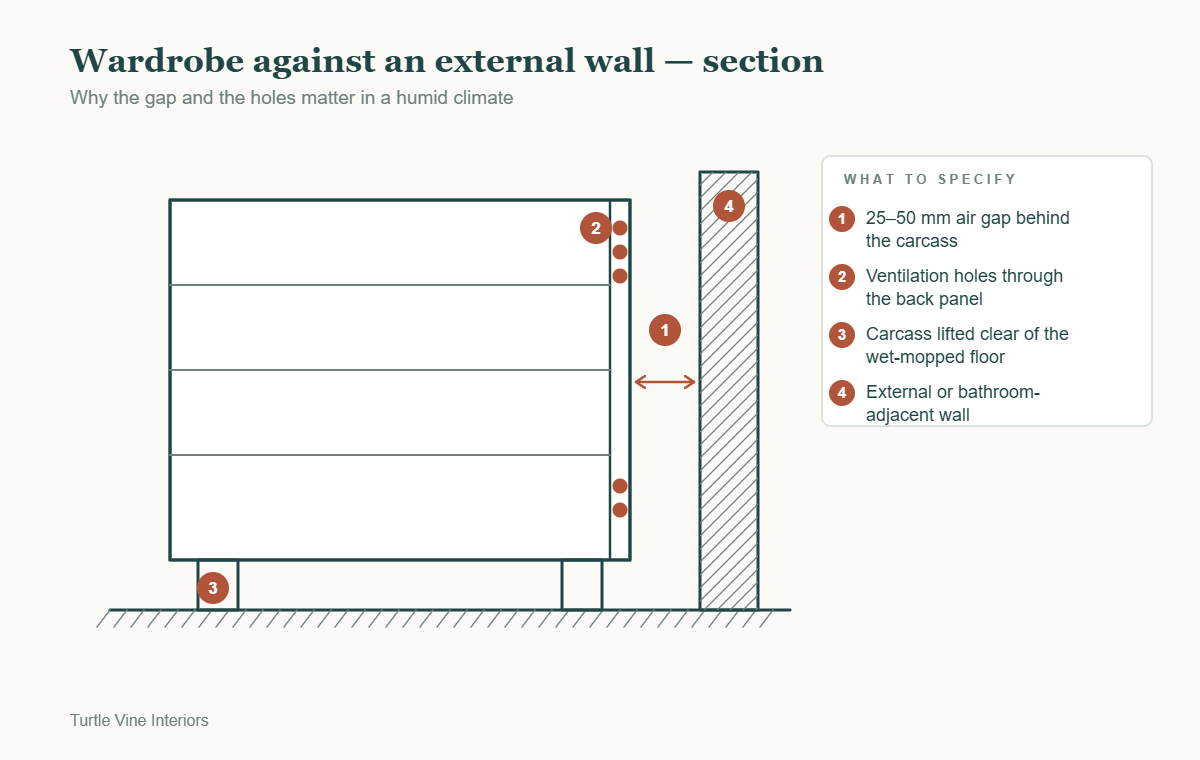
A wardrobe pushed flat against an external wall, or a wall that shares plumbing with a bathroom, has no way to dry. Moisture moves through the masonry, sits in the gap that isn’t there, and within a monsoon or two the clothes smell of it.
Leaving a gap between the carcass back and the wall, and putting a few discreet ventilation cut-outs in the back panel or the top, solves a problem that people otherwise treat with camphor for years.
Under the sink, and behind the kitchen
Under-sink cabinets fail before anything else in the house, because they combine a slow leak with a closed box. The utility area is a close second.
These are the two places worth specifying differently from the rest of the kitchen — a board that does not care about water at all, rather than the one that matches everywhere else.
The decisions that matter at design stage
These are cheap now and impossible later, which is why it helps to have your interiors planned alongside the building rather than after it. If you are still at the stage of settling layouts and wet areas, this is one of the things a residential interiors plan should be resolving on paper, not on site.
Keep timber off the floor and off wet walls
Anything that stands on the floor should stand on legs or a sealed plinth, not on its own base. Anything fixed to an external or bathroom-adjacent wall should have a gap behind it, or a moisture barrier, or ideally both.
Ventilate anything that stays shut
Wardrobes, storage lofts, under-stair cupboards, shoe racks near the entrance. Every closed volume in a humid house needs some way for air to move, even if it is only a louvred panel or a line of holes hidden at the top.
Treat wet zones as a different problem
Bathroom vanities, utility cabinets, the under-sink unit, and any storage in an open sit-out are not the same problem as a bedroom wardrobe, and specifying them with the same board is how you end up replacing them first.
Specifying for humidity: boards, edges, hardware, finishes
Boards and grades
Plywood in India is graded, and the grade is the whole point. IS:303 MR grade — moisture resistant — is a bonding grade for dry interiors, not a claim that the board survives water. IS:710 BWP, bonded with phenolic resin, is the grade meant for wet and persistently humid applications.
For a Kerala home, IS:710 belongs anywhere near water, and MR grade is fine in dry rooms if the cost difference matters to you. Solid wood, properly seasoned, is stable and repairable and takes a finish beautifully — it simply needs to be detailed with room to move.
At Turtle Vine we lead with solid wood for made-to-order pieces and use IS:710 marine plywood where the application genuinely calls for it — wide flat panels, curved work, carcass backs — and the furniture customization quotation names which part uses what, so you can see the reasoning rather than take it on trust.
MDF and particle board have real uses — painted shutters, routed profiles, anywhere a perfectly flat paintable surface matters. They do not belong under a sink or at floor level in a bathroom.
Edges and adhesives
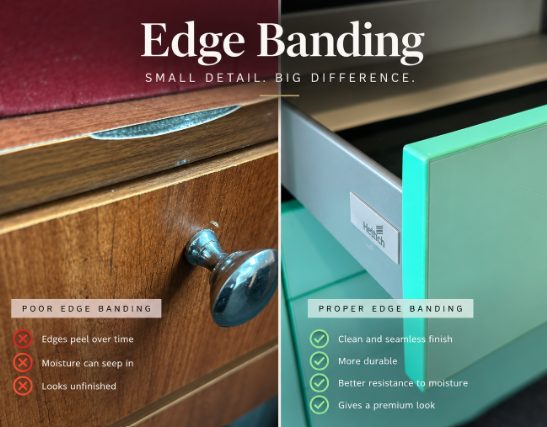
An edge is where moisture gets in. Thicker PVC edge banding on shutters and exposed panels is worth the small extra; thin banding on a high-traffic kitchen shutter starts peeling at a corner and then invites water into the core.
Ask what adhesive is being used, too. Phenolic-bonded boards hold up in damp conditions in a way urea-formaldehyde ones do not.
Hardware and fasteners
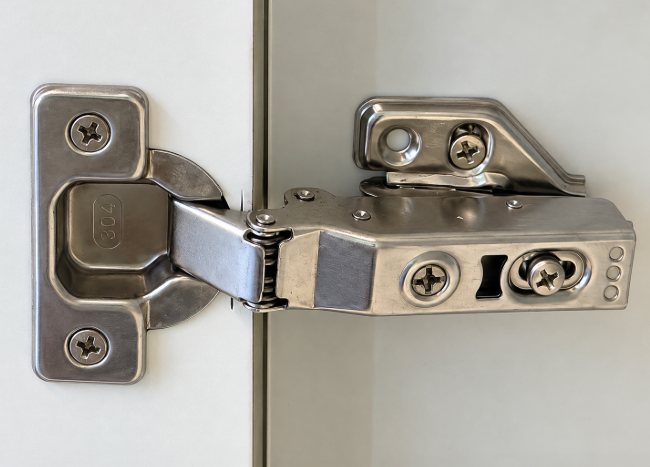
This is the one most people never ask about, and near the coast it matters. Mild steel hinges, screws and channels rust in humid air; stainless steel does not. Rusted hinges are the reason wardrobe shutters start sagging years before the wardrobe itself has any problem.
If a quotation lists hardware by brand and grade rather than as “hardware — lumpsum”, that is a good sign about everything else in it.
Finishes
No finish waterproofs a board — it slows moisture exchange and buys you time to wipe a spill. What differs is repairability.
PU and polish on solid wood can be sanded and redone years later. Laminate and acrylic cannot be repaired once a seam lifts; they are replaced. Matte finishes hide the fine scratches that humid-climate cleaning produces, while high gloss shows every one of them. None of these is wrong — but pick knowing which one you are choosing.
Termite prevention that actually works
In order of how much difference it makes:
- Pre-construction anti-termite treatment. By far the most effective step, and only available once. If your house is still being built, do not skip it.
- Break the soil-to-timber path. No untreated wood resting on the floor, no timber buried into masonry, sealed gaps where pipes pass through slabs and walls.
- Fix the water. Termites follow moisture. A leaking pipe inside a wall or a damp patch under a window is an invitation, and no amount of treated timber makes up for it.
- Inspect the quiet places. The back of storage units, the underside of lofts, the skirting behind heavy furniture. Mud tubes are visible if anyone looks.
Chemical treatment of the timber itself is a genuine layer of protection, but it comes last, not first.
What you can do that costs nothing
- Open wardrobes and closed storage for an hour on dry days, particularly after a long spell of rain.
- Don’t dry clothes inside a bedroom that also holds a full wardrobe.
- Run the kitchen and bathroom exhausts long enough to actually clear the moisture, not just during cooking.
- Wipe standing water off a shutter base rather than letting it sit.
- Keep heavy furniture a couple of inches clear of external walls.
None of this is dramatic. Together it is the difference between furniture that ages and furniture that deteriorates.
When the furniture isn’t the problem
Sometimes a wardrobe smells damp because the wall behind it is wet, and the wall is wet because of a failed sunshade, a blocked rainwater outlet, a leaking pipe in the adjacent bathroom, or plaster that was never given a chance to dry.
Replacing the wardrobe will not fix any of those. Before re-doing interiors that have gone bad, it is worth finding out whether the building is the cause — a question our team asks on every renovation walkthrough, and the reason some of the projects we take on start with waterproofing rather than joinery.
Frequently asked questions
Is marine plywood necessary for the whole house?
No. IS:710 belongs where water is genuinely present or the panel is doing structural work — kitchens, bathrooms, utility areas, wide flat panels, carcass backs. In dry bedrooms and living rooms, good solid wood or MR-grade ply is sensible and costs less.
Why does my wardrobe smell damp even though nothing is wet?
Almost always because it sits flush against a wall that holds moisture, with no ventilation inside. Pull it off the wall, add ventilation, and check whether the wall itself is damp.
Does laminate protect against humidity?
It protects the surface it covers. The edges and the core are the weak point, which is why edge banding quality matters more than the laminate brand.
Are termites a problem in apartments too?
Less often on upper floors, since subterranean termites travel up from soil, but not never — they follow plumbing shafts and damp walls. Ground and first-floor apartments should take the same precautions as a house.
Should furniture be made in the monsoon?
It can be, provided the timber is properly seasoned and stored dry. The risk is not the season — it is timber that arrives on site wet and is worked before it stabilises.
Planning interiors for a home in Trivandrum?
Send us your floor plan and we’ll tell you which areas need wet-zone specification and where a standard build is perfectly adequate — before anything is ordered. Book a consultation.